Showing posts with label landscape. Show all posts

Wednesday, January 15, 2014

Northern Light: Anders Zorn in San Francisco


Walk, Anders Zorn, 1906 (photo in public domain).
I traveled to San Francisco last weekend to visit friends and see two exhibitions: Anders Zorn at the Palace of the Legion of Honor, and David Hockney at the DeYoung. Different in style, scope, and scale, they were both worth the trip.

Aside from painting and teaching, visiting museums is one of my favorite pastimes, and the Palace of the Legion of Honor did not disappoint. The Zorn show included 100 works of watercolor and oil paintings, prints, and a few small bronze statuettes.

Anders Zorn (1860-1920) was a Swedish painter whose career rivaled that of his contemporaries, including French impressionists like Claude Monet and the American portrait painter John Singer Sargent. Zorn began painting at an early age, mastering watercolors while in his teens. At the height of his career, in the early 1900s, he was reportedly earning $15,000 per week from his portraits, including three of our American presidents; a large, casual portrait of Theodore Roosevelt was included in this exhibit.

Summerdance, Anders Zorn
(photo in public domain)

His watercolors demonstrate complete confidence in his palette, from which he captures the beauty of skin tones suffused in a softly dispersed light. He mastered the art of painting water, posing figures and boats in compositions which feature the complex surface and depths of the waters around them. He moved on to oil painting as he traveled through Europe and Algeria, interacting with other artists and gaining increasingly significant portrait commissions as well as capturing the customs, costumes, and landscapes.

There was a series of stunning nude figures in the landscape, often portrayed bathing in the cold northern lakes of Scandinavia. It was interesting to see them as prints and also as larger oil paintings. Zorn was equally adept at landscapes and still life work, but for me, his figures were the most breathtaking. In addition to what might be considered “celebrity portraits,” he devoted his energies toward capturing the culture and people of the rural Swedish countryside where he grew up, and this legacy is a gift to us today.

For icing on the cake, there was a small Matisse exhibit next door. After the light-infused impressions of Zorn, Matisse’s works seem shocking with their the flat surfaces and brilliant, gaudy colors. The contrast gives a sense of the shock to the art world when Matisse first presented his work, and a visit to the two shows is like a condensed trip into art history.
And now for something completely different:
Portrait of Lydia Delectorskaya by
Henri Matisse (arthermitage.com)


Friday, January 3, 2014

The Color of Snow

Watercolor study of the Huron
River in winter, Ann Arbor,
Michigan.
As an art teacher, I try to teach my students to see the world, to become careful observers. So many people travel through life unaware of this incredible world we share, and if we are to raise our children to be thoughtful stewards of the earth and all its inhabitants, first they have to appreciate and be grateful for it. For me, gratitude for this life begins with appreciation of beauty and nature, and that appreciation begins with seeing and experiencing.


Snowy woods in Ann Arbor,
Michigan (watercolor).
This winter storm blasting friends and family across the northeastern United States and Western Europe brought to mind one of my favorite paintings by one of my favorite painters, Claude Monet. His painting, La Pie (The Magpie), painted around 1868, is in the Musée d’Orsay in Paris and several years ago traveled to the DeYoung Museum in San Francisco. Even though I’d seen it in Paris, I traveled to San Francisco to see it again; and later when I was in Paris, I went to see it again. I am a bit of a Monet junkie, I suppose, but there is no comparison to seeing his paintings in person. 
The painting depicts a black bird in a snow-covered landscape near Etretat and was painted on location. It was rejected by the jury of the famed Salon in 1869, according to the Musée d’Orsay, because Monet was more interested in perception than description, as was the custom of the respected painters of the day. What I love about the painting is that Monet captured that perception – you can feel the air, the cold, still tranquility of the winter’s day that Monet experienced. It’s all there, almost 150 years later.  


La Pie, Claude Monet, 1868, courtesy of the Musee d'Orsay.
As for my students, this painting is a way to get them to observe subtlety in the world. When I ask my students “What color is snow?” they unanimously answer “White!” (in spite of the fact that we are in Southern California, we occasionally get snow on the  mountains behind our town and most of my students have travelled to places where snow actually happens).

Yet when we take piece of bright white paper and place it over Monet’s snow-covered landscape, we find all kinds of colors – blues, pinks, purples, yellows. My students love this discovery – such a surprise! Snow is purple! When we really look at a snow-covered landscape we will discover the same thing, but only if we look carefully. The best feedback an art teacher can receive is from a parent who says “My kid showed me that snow can be purple – who knew?”
We also have wonderful discussions about the color of water, but I’ll save that for a rainy day (not forecast anytime soon around here, sadly).

Thursday, November 14, 2013

Inside Outside Redux

"But you know all pictures painted inside, in the studio, will never be as good as those done outside. When out-of-door scenes are represented, the contrast between the figures and the ground is astounding and the landscape is magnificent. I see some superb things and I shall have to make up my mind only to do things out-of-doors."
                                                  - Paul Cezanne in a letter to Emile Zola, 19 October 1866

My studio is nice, but not this nice.
I love to paint in the studio, where the light doesn’t change and the wind can’t blow over your easel, dogs won’t lift a leg on your stuff, rattlesnakes and bulls won’t taunt you*, and people don’t come by and comment on what you’re working on or worse, blather on about whatever strange concept they’re working on; yes, I’ve witnessed all of these. 
Renny's, 18 x 24" oil on canvas.

So perhaps I complained about the challenge of the changing shadows as they fell longer through the afternoon, and my friend and painting compadre Kit whipped out this quotation as we were wrapping up a marathon day at the fabulous Hollister Ranch on the California coast.

Plenty of room: Lori & Kit at Renny's.

I have to agree with Cezanne: often you can tell if a painting was executed en plein air or from photographs in the studio. Painters who have logged thousands of hours outside can master the challenge, but others, well, not so much. You can tell, sometimes by the colorless shadows, exaggerated light, or strange details, that a painter hasn’t planted an easel in the dirt very often. Not that there’s anything wrong with that, except, as Cezanne says, those indoor pictures will never be as good.

Even the best of cameras can’t capture the subtleties of light and millions of hues that radiate into the human eye and are interpreted by the wondrous visual cortex, the largest system in the human brain. But that’s not the only reason that landscapes painted in the studio fall flat.

I don’t typically paint landscapes indoors; I paint from life, real flowers, fruits, or whatever piques my interest in the garden and studio on a given day.  In spite of the changing light and other challenges, I still prefer to stand in the beautiful landscape to capture not just a picture, but the air, the breeze, the softness of dirt or the sounds of water or wind.
El Capitan, 16 x 20" oil on canvas
Yesterday in Carpinteria an osprey perched in a eucalyptus tree directly above us and seals barked at the bottom of the bluffs behind us. Somehow all of these sensations are woven into the essence of a painting done outdoors, but they won’t be found in the sterile air of the studio.

Temporary studio at El Cap.

 *stay tuned for the snake story in a future post


Wednesday, October 23, 2013

Back in the USSR


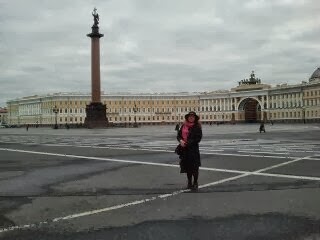
Outside the Winter Palace (aka Hermitage)
I knew when I set out on the 30 paintings in 30 days challenge that it would be a . . . well, a challenge. For me, the biggest challenge was a trip to the Baltic countries (Lithuania, Latvia, Estonia) and St. Petersburg, which my octogenarian mother invited me to accompany her on as part of her bucket list tour. Who could say no?
Optimistic as I am, I brought along art supplies, not accounting for the cold, rainy weather, which was not conducive to painting outside. Inside was not a good option either, as we were quite busy.
However, we saw fabulous art and architecture and contemplated deep history and culture. As much as I love watching football, nothing surpasses the thrill of standing in front of an incredible work of art and sensing firsthand what the artist saw as he or she stood in front of it, whether recently or 1,000 years ago. Masterpieces are undeniable in their execution, their composition, their color, their bravura – qualities that define them. For me, it is a sensation of awe, of desire, a visceral experience that defines a masterpiece.
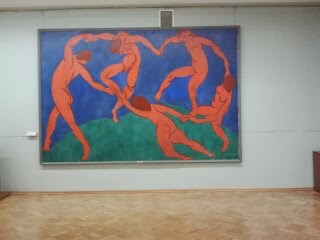
Matisse's Dance, larger than life.
The pinnacle of the trip (from an art perspective) was the Hermitage Museum in St. Petersburg, Russia. There can never be enough time there, what with 3,000,000 works in the collection, but our small group had the good fortune to be admitted two hours before opening time. We were alone in those great galleries, having a tête-à-tête with Rembrandt’s soulful portraits and Matisse’s giant, joyful dancers. From Caravaggio to Rubens to Picasso we wandered through brilliance and it was exhilarating.


I always love Cezanne's
still life & landscapes.
I studied in what was then Leningrad for a summer in the USSR as a student in 1985. To quote Paul McCartney, “Been away so long I hardly knew the place,” and it was remarkable to see the changes in the post-Soviet era. As a reminder of how powerful art can be, Wikipedia reports that the Beatles were labeled in the 1960s as the "belch of Western culture," and the Soviets denied permission in the 1980s (!) for Paul McCartney to play there.

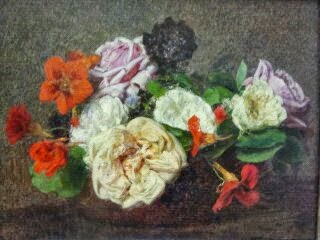
My favorite floral painter, Henri Fantin-Latour.
Of course there were far more serious ramifications for displeasing the Soviets, including torture, murder, and exile to Siberia. Unfortunately, it seems as if the current Russian administration has not fallen far enough from that tree, in spite of significant improvements in daily life for many (but definitely not all) the Russian people. Still, the art alone was worth the visit, not to mention being with my intrepid and ever-curious mother, from whom I have inherited a deep love of travel and art, among other things.


With Mom at Peterhof, the Summer Palace on the Baltic.


Wednesday, September 11, 2013

A Little Bit of Everything (almost)

I met an abstract painter last week who was encouraging me to make a foray into abstract painting, as opposed to my comfortable zone of realism/impressionism. I told him I felt like I could spend a lifetime trying to master what I already do, and that working abstract would pull me away from that. He suggested that abstract work might enhance what I do, and my intuition tells me he might be right.
That being said, I am still playing catch up with 30 paintings in 30 days, and today I touched on the three genres I paint with some regularity - still life, landscape, and figure. Almost caught up!
Canteloupe & Grapes, 5x7" oil on gessoboard, $125

Tarpits Rocks, 8x10" oil on linen on board, $200

Lori Sketching on the Beach, 5x7" oil on gessoboard

Sunday, August 4, 2013

On Monhegan

Monhegan Island Morning, Rebecca Stebbins, 2013
I was asked by a modern sculptor who saw my work online, “What’s the point of doing things that have already been done?” It came off like an affront, but I believe his point was that ‘real’ artists should push forward, seek new forms of expression, reinvent genres and challenge the status quo. I respect his point, for without it we could never have opened the door to a Vincent Van Gogh or Maya Lin. There are also artists whose attempts to shock the world seem more like self-indulgent fodder for a therapy couch than seeds for a new movement in art, but even the art world has its Betamaxes and New Coke.

My artwork is impressionistic, representational, or as a friend says, I paint things that look like things. It is what I love to do and to look at, whether a Monet landscape or a Chardin still life. I leave it to others to shock, repel, or disgust their audiences, or to confront them with difficult challenges. There is room enough in the art locker for all of us.
Edward Hopper, High Noon, 1949
I am painting for a few days on Monhegan Island, 10 miles off the coast of Maine. The 50 or so local residents call it “the rock,” and it is: a giant, rugged rock topped by pine forests and surrounded by the cold, swirling riptides and currents of the Atlantic Ocean. Monhegan has Maine’s highest cliffs, dropping 168 feet into the sea.

This place  has drawn people for thousands of years for its rich fishing; there is still a working harbor, primarily lobster boats. For 150 years the island has also called to artists, and many iconic American painters have painted here.
Everywhere here I see a Hopper painting. Edward Hopper was a distinctive American artist who forged a unique style that was sparse and clean. He often painted New York and Paris, and here, where his eye was drawn to the crisp lines of the dormered houses against the profoundly blue sky, or rusty rocks in a deep teal ocean.

Edward Hopper, Blackhead, Monhegan 1919
The current exhibition at the Monhegan Art Museum in the lighthouse features Monhegan artists who were affiliated with the New York Armory show in 1913, a watershed moment in American art history. Most of the paintings, by Robert Henri, Leon Kroll and others, are bold, modern landscapes. One would expect Hopper’s stark houses or rugged rocks here, but instead we find his still life painting of a jug and copper bowl, in tonal shades that look very much like Chardin.

Jean-Siméon Chardin, Still Life, c.1732


Edward Hopper, Jug & Copper Bowl
1903
French painter Jean Baptiste Simeon Chardin was a master of the beautiful, painterly still life works he created in the 18th century. So here was Hopper in 1903, considered modern, ground-breaking and unique in his approach to his subjects, painting in the style of a Frenchman who had “done it already” centuries earlier. I wonder if anyone ever asked him, “What’s the point -- it’s been done before?” The piece was lovely, if a little out of place amongst modernist landscapes. I like to believe that Hopper found value in still life painting in the way that I do: as an opportunity to take a fresh look at old forms, a study in relationships, an exercise in seeing things as they are.   


*******************************************************************************************
My Sweet Cherries, Rebecca Stebbins 2013