
Showing posts with label art history. Show all posts

Wednesday, October 23, 2013

Back in the USSR


Outside the Winter Palace (aka Hermitage)
I knew when I set out on the 30 paintings in 30 days challenge that it would be a . . . well, a challenge. For me, the biggest challenge was a trip to the Baltic countries (Lithuania, Latvia, Estonia) and St. Petersburg, which my octogenarian mother invited me to accompany her on as part of her bucket list tour. Who could say no?
Optimistic as I am, I brought along art supplies, not accounting for the cold, rainy weather, which was not conducive to painting outside. Inside was not a good option either, as we were quite busy.
However, we saw fabulous art and architecture and contemplated deep history and culture. As much as I love watching football, nothing surpasses the thrill of standing in front of an incredible work of art and sensing firsthand what the artist saw as he or she stood in front of it, whether recently or 1,000 years ago. Masterpieces are undeniable in their execution, their composition, their color, their bravura – qualities that define them. For me, it is a sensation of awe, of desire, a visceral experience that defines a masterpiece.
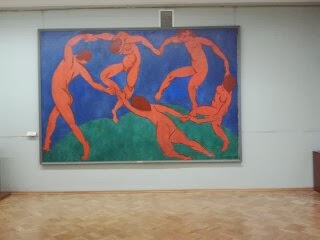
Matisse's Dance, larger than life.
The pinnacle of the trip (from an art perspective) was the Hermitage Museum in St. Petersburg, Russia. There can never be enough time there, what with 3,000,000 works in the collection, but our small group had the good fortune to be admitted two hours before opening time. We were alone in those great galleries, having a tête-à-tête with Rembrandt’s soulful portraits and Matisse’s giant, joyful dancers. From Caravaggio to Rubens to Picasso we wandered through brilliance and it was exhilarating.


I always love Cezanne's
still life & landscapes.
I studied in what was then Leningrad for a summer in the USSR as a student in 1985. To quote Paul McCartney, “Been away so long I hardly knew the place,” and it was remarkable to see the changes in the post-Soviet era. As a reminder of how powerful art can be, Wikipedia reports that the Beatles were labeled in the 1960s as the "belch of Western culture," and the Soviets denied permission in the 1980s (!) for Paul McCartney to play there.
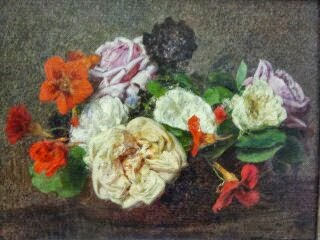
My favorite floral painter, Henri Fantin-Latour.
Of course there were far more serious ramifications for displeasing the Soviets, including torture, murder, and exile to Siberia. Unfortunately, it seems as if the current Russian administration has not fallen far enough from that tree, in spite of significant improvements in daily life for many (but definitely not all) the Russian people. Still, the art alone was worth the visit, not to mention being with my intrepid and ever-curious mother, from whom I have inherited a deep love of travel and art, among other things.


With Mom at Peterhof, the Summer Palace on the Baltic.


Sunday, August 4, 2013

On Monhegan

Monhegan Island Morning, Rebecca Stebbins, 2013
I was asked by a modern sculptor who saw my work online, “What’s the point of doing things that have already been done?” It came off like an affront, but I believe his point was that ‘real’ artists should push forward, seek new forms of expression, reinvent genres and challenge the status quo. I respect his point, for without it we could never have opened the door to a Vincent Van Gogh or Maya Lin. There are also artists whose attempts to shock the world seem more like self-indulgent fodder for a therapy couch than seeds for a new movement in art, but even the art world has its Betamaxes and New Coke.

My artwork is impressionistic, representational, or as a friend says, I paint things that look like things. It is what I love to do and to look at, whether a Monet landscape or a Chardin still life. I leave it to others to shock, repel, or disgust their audiences, or to confront them with difficult challenges. There is room enough in the art locker for all of us.
Edward Hopper, High Noon, 1949
I am painting for a few days on Monhegan Island, 10 miles off the coast of Maine. The 50 or so local residents call it “the rock,” and it is: a giant, rugged rock topped by pine forests and surrounded by the cold, swirling riptides and currents of the Atlantic Ocean. Monhegan has Maine’s highest cliffs, dropping 168 feet into the sea.

This place  has drawn people for thousands of years for its rich fishing; there is still a working harbor, primarily lobster boats. For 150 years the island has also called to artists, and many iconic American painters have painted here.
Everywhere here I see a Hopper painting. Edward Hopper was a distinctive American artist who forged a unique style that was sparse and clean. He often painted New York and Paris, and here, where his eye was drawn to the crisp lines of the dormered houses against the profoundly blue sky, or rusty rocks in a deep teal ocean.

Edward Hopper, Blackhead, Monhegan 1919
The current exhibition at the Monhegan Art Museum in the lighthouse features Monhegan artists who were affiliated with the New York Armory show in 1913, a watershed moment in American art history. Most of the paintings, by Robert Henri, Leon Kroll and others, are bold, modern landscapes. One would expect Hopper’s stark houses or rugged rocks here, but instead we find his still life painting of a jug and copper bowl, in tonal shades that look very much like Chardin.

Jean-Siméon Chardin, Still Life, c.1732


Edward Hopper, Jug & Copper Bowl
1903
French painter Jean Baptiste Simeon Chardin was a master of the beautiful, painterly still life works he created in the 18th century. So here was Hopper in 1903, considered modern, ground-breaking and unique in his approach to his subjects, painting in the style of a Frenchman who had “done it already” centuries earlier. I wonder if anyone ever asked him, “What’s the point -- it’s been done before?” The piece was lovely, if a little out of place amongst modernist landscapes. I like to believe that Hopper found value in still life painting in the way that I do: as an opportunity to take a fresh look at old forms, a study in relationships, an exercise in seeing things as they are.   


*******************************************************************************************
My Sweet Cherries, Rebecca Stebbins 2013


Monday, July 29, 2013

Telling Stories


St. Genevieve & St. Apollonia,
from the National Gallery. Note the
pliers, and tooth.
I feel besieged by gruesome tales of late: of young women held captive and abused for years; of alienated young men with an affinity for gunning down innocent victims. We share this collection of fables with each other, seeking to understand our human existence with its undercurrent of fear and anxiety fed by the media. These stories also disengage our focus from nefarious acts perpetrated by our corporations, institutions and governments.

Stories of evil are nothing new. Long before FOX News there were artists, and the Church, and between them they perpetrated sensational stories that resonated in the same vein: tales of horror, torture and abuse, with a purpose and a warning: morality lessons, as it were. They once invaded the collective consciousness the way FOX News, the New York Times and CNN do today.  

In London recently I saw Michael Landy’s exhibit Saints Alive at the National Gallery. Landy was invited as artist-in-residence to stage an exhibition reflecting the museum’s collection. He spent countless hours immersed in this major collection of European paintings, sketching and copying works from medieval Italians to French Impressionists, honing his unique response.

More than visual images, Landy was viewing stories in paint. The majority of medieval works have religious themes, which continued through the Renaissance and beyond. Many tell stories of Christian saints, their martyrdom or self-inflicted violence. A theme thus emerged which Landy has brought to life in Saints Alive.
St. Jerome & his rock.
From the National Gallery
Over centuries, perhaps accelerating in recent decades, these stories have faded from the collective consciousness. As these stories are lost to time, Landy has reconstructed a few in a way that makes them unforgettable.

Composing body parts based on old paintings combined with industrial salvage, Landy has masterminded larger-than-life sculptures . These giant figures inflict their torment upon themselves – but only at our command. The interactive exhibit invites the viewer to set the violence in motion through the push of a pedal.  

We first see an 8-foot tall Saint Apollonia, based upon this painting by Luis Cranach the Elder from 1506 (above). Landy has fashioned our saint in her red dress, clutching pliers in which she holds a tooth. Poor virginal Apollonia was attacked by a mob who yanked out her teeth and invited her to renounce her faith or be burned on a pile of sticks. As the story goes, she jumped on the sticks. Today she is the patron saint of toothaches and dentists.
Step on an industrial foot pedal peeking out from under her dress, and the giant saint whacks herself in the mouth with her oversized pliers, chipping away at her plaster face with a loud bang. It’s a shocking interaction, as is the nearby life-sized St. Francis, who whacks himself on the forehead with a crucifix upon the deposit of a coin. Other icons show us of St. Lucy, who plucked her own eyes out and sent them to an admirer, and St. Jerome, a hermit in the Syrian desert, who beat himself with a rock to stave off impure sexual thoughts.

The scale and mechanics of these larger-than-life Saints, with the racket of their machinations, makes a startling impression, generating a cacophony rarely heard in the hushed world of the museum. I found myself laughing – these stories of torment are turned into parodies by their scale and haphazard assembly and clanging mechanics. Have we moved beyond the morality tale? Do we no longer need to beat ourselves with rocks to avoid impure thoughts? Or do we no longer need to avoid impure thoughts? These stories were told and retold for centuries, while the Church refined its own blend of torment and abuse, sanctioning violence and protecting pedophiles. Taken outside the purview of the church, when we reserve our horror for individual tales of violence courtesy of the media, are we blinded to the institutionalized abuses taking place? This is a thought-provoking exhibition and worth the visit. (for information visit www.nationalgallery.co.uk)    

Friday, January 11, 2013

A Matter of Taste?


The Magpie
The Magpie by Claude Monet. Worn out or enduring?

Being a painter allows me to explore a life of introspection and discovery. My aim is to continually learn, sharpen my skills and deepen my understanding of what I want to convey through my work. I am interested in beauty, and my goal is to discover beauty and to share it, to encourage other people to care about the beauty of our natural and artisanal world, and to understand how precious and how fragile it is.

When I paint outside, I choose to paint the landscapes I love, mostly in California and in France. I am drawn to the rugged beauty of the coast and the mountains, and to the quality of illumination that exists in certain places and at certain times. I am looking for the shapes and colors that work together to tell a story or invoke a sensation.

When I wrestle with the challenge of creating something new or saying something profound, I am drawn back to the enduring appeal of the paintings of the French and California Impressionists. They were groundbreaking artists of their time, and now they are not. Still, many people are drawn to their paintings, which command astronomical prices and sold out museum shows. So are they old and worn out? Or did they create something timeless? I believe there is value in discovery and innovation, and there are plenty of contemporary artists whose work I admire who are pursuing beauty in new and different ways. I also believe that in 100 years we may not be so captivated by pickled sharks and rumpled bed sheets posing as art. But we may still be enchanted by the dance of light on a haystack, or the curl of shadow underneath a wave. And as long as there is magic to be found in the lightness of the world, there will be value, for me, in painting it.
  
Damien Hirst, The Physical Impossibility of Death in the Mind of Someone Living.
Natural history, or art history? Or just a pickled shark?